


Work on 6G has started much earlier than previous generations of mobile technology. Even though commercial deployment is still years away, governments across multiple regions are actively pushing telecom operators, research institutions, and vendors to increase investment in research and development. This push is not limited to funding alone. It includes spectrum planning, standardization efforts, academic collaboration, and early-stage trials. So, now let us see Why do governments believe that countries delaying investment in 6G R&D risk falling behind along with User-friendly LTE RF drive test tools in telecom & RF drive test software in telecom and User-friendly 4G Tester, 4G LTE Tester, 4G Network Tester and VOLTE Testing tools & Equipment in detail.
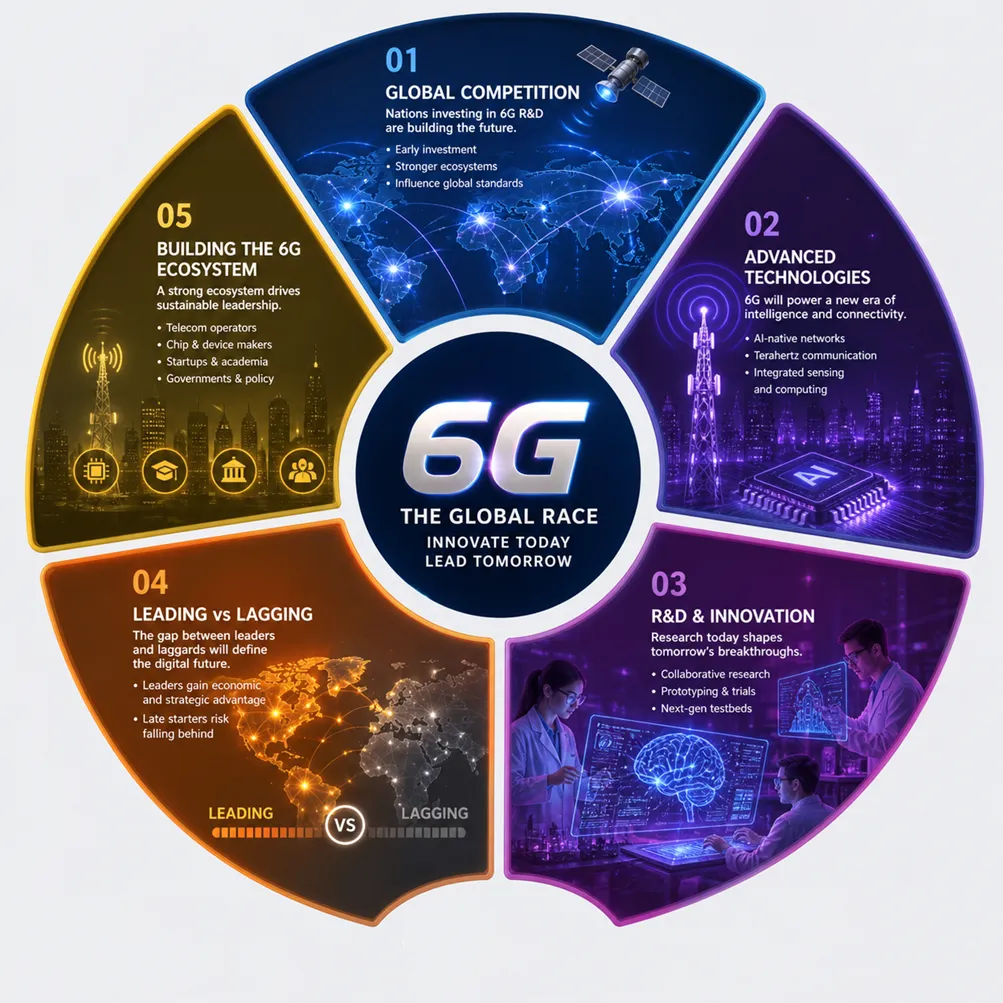
The main concern driving this activity is global competitiveness. Countries that led early in 4G and 5G were able to build strong ecosystems around telecom infrastructure, device manufacturing, and application development. These advantages translated into economic and strategic benefits. With 6G, governments are trying to avoid a delayed start. The idea is simple: if investment begins late, the gap becomes difficult to close.
Unlike earlier generations, 6G development is being treated as a long-term national initiative rather than a purely industry-driven upgrade. Governments are setting up dedicated programs to fund research in areas such as advanced radio technologies, new spectrum bands, and AI-based network control. Universities and research labs are being encouraged to work closely with telecom companies to test new concepts before standardization begins.
One key area of focus is spectrum. 6G is expected to use higher frequency bands, including sub-terahertz ranges. These frequencies can support very high data rates due to wider bandwidth availability. At the same time, they introduce technical challenges such as signal loss, limited coverage, and sensitivity to obstacles. Governments are supporting studies to understand how these bands can be used effectively. This includes field trials, propagation modeling, and hardware testing.
Another focus area is network architecture. 5G introduced concepts like network slicing and edge computing. 6G is expected to extend these ideas further by integrating computing, communication, and sensing into a unified system. Governments are funding research that looks at distributed network designs, where processing is shared across multiple nodes instead of being centralized. This approach helps reduce latency and improves reliability for applications that require real-time response.
Artificial intelligence is also a central part of 6G research programs. Unlike earlier networks where AI was used mainly for monitoring and optimization, future systems are expected to rely on AI for core operations. This includes resource allocation, traffic prediction, and fault handling. Governments are encouraging development of AI models that can operate within network environments, making decisions based on live data.
Security is another area receiving attention. As networks become more complex and support more connected devices, the attack surface increases. Governments are pushing for secure-by-design architectures, where encryption, authentication, and threat detection are integrated from the beginning. This is especially relevant for use cases such as connected infrastructure, remote operations, and automated systems.
The push for 6G research is also linked to industrial applications. Future networks are expected to support automation in manufacturing, smart transportation systems, remote healthcare, and large-scale sensor networks. These use cases require consistent performance, low latency, and high reliability. Governments see this as an opportunity to improve productivity across sectors, which is why telecom research is being aligned with broader economic goals.
International collaboration is another part of the strategy. While countries are competing to lead in 6G, they are also participating in global standardization bodies. This ensures that technologies developed locally can be adopted globally. Standardization will define how devices, networks, and services interact. Early participation in this process gives countries a chance to influence these definitions.
Despite the strong push, it is clear that 6G is still in the early stages. Most of the work today is focused on research and testing rather than deployment. There are no finalized standards, and commercial devices are not yet available. However, the timeline for development is long. It typically takes several years to move from research to standardization and then to large-scale deployment. Starting early allows enough time to address technical challenges and align industry stakeholders.
Another reason for early investment is ecosystem development. Telecom systems depend on multiple components, including chipsets, devices, infrastructure, and software platforms. Building this ecosystem requires coordination across different industries. Governments are supporting startups and small companies that can contribute to specific parts of this chain, such as antenna design, signal processing, or network analytics.
Funding models vary by region, but the overall goal remains consistent: accelerate research while reducing dependency on external technologies. Some countries are focusing on building local manufacturing capabilities, while others are investing in software and system design. In both cases, telecom infrastructure is seen as a strategic asset.
From a technical perspective, early 6G research is already showing promising results. Test environments have demonstrated higher data rates, improved latency, and better resource management compared to 5G. However, these results are limited to controlled conditions. Scaling these improvements to real-world deployments will require further development.
In summary, governments are actively pushing telecom companies to increase R&D efforts for 6G due to long-term strategic and economic reasons. The concern is that delayed investment could result in loss of competitiveness. Even though 6G deployment is still years away, the groundwork is being laid now through research programs, funding initiatives, and early trials. The race has already started, and progress during this phase will shape how future networks are built and adopted.
About RantCell
RantCell helps teams simplify mobile network testing by turning standard Android devices into powerful measurement tools. From indoor surveys to large-scale drive testing, it provides clear visibility into network performance with easy-to-use dashboards, automated reporting, and scalable deployment options. It’s built to reduce complexity while maintaining the depth needed for advanced analysis. Also read similar articles from here.