


South Korea continues to be one of the most advanced telecom markets, especially in 5G deployment and early stage 6G work. Operators such as SK Telecom, KT, and LG U+ have built dense 5G networks with both Sub 6 GHz and mmWave layers. With this level of deployment density, the need for accurate network validation has increased significantly. One of the most reliable ways to understand network behavior at a deeper level is through L1, L2, and L3 logging.
These logs are not new concepts, but their importance has grown due to the complexity of 5G NR networks. Field engineers in South Korea rely heavily on protocol level logging to troubleshoot issues that cannot be identified through standard KPI based tools. So, now let us look into L1 / L2 / L3 Network Logging in South Korea along with User-friendly LTE RF drive test tools in telecom & Cellular RF drive test equipment and User-friendly Wireless Survey Software Tools & Wifi site survey software tools in detail.
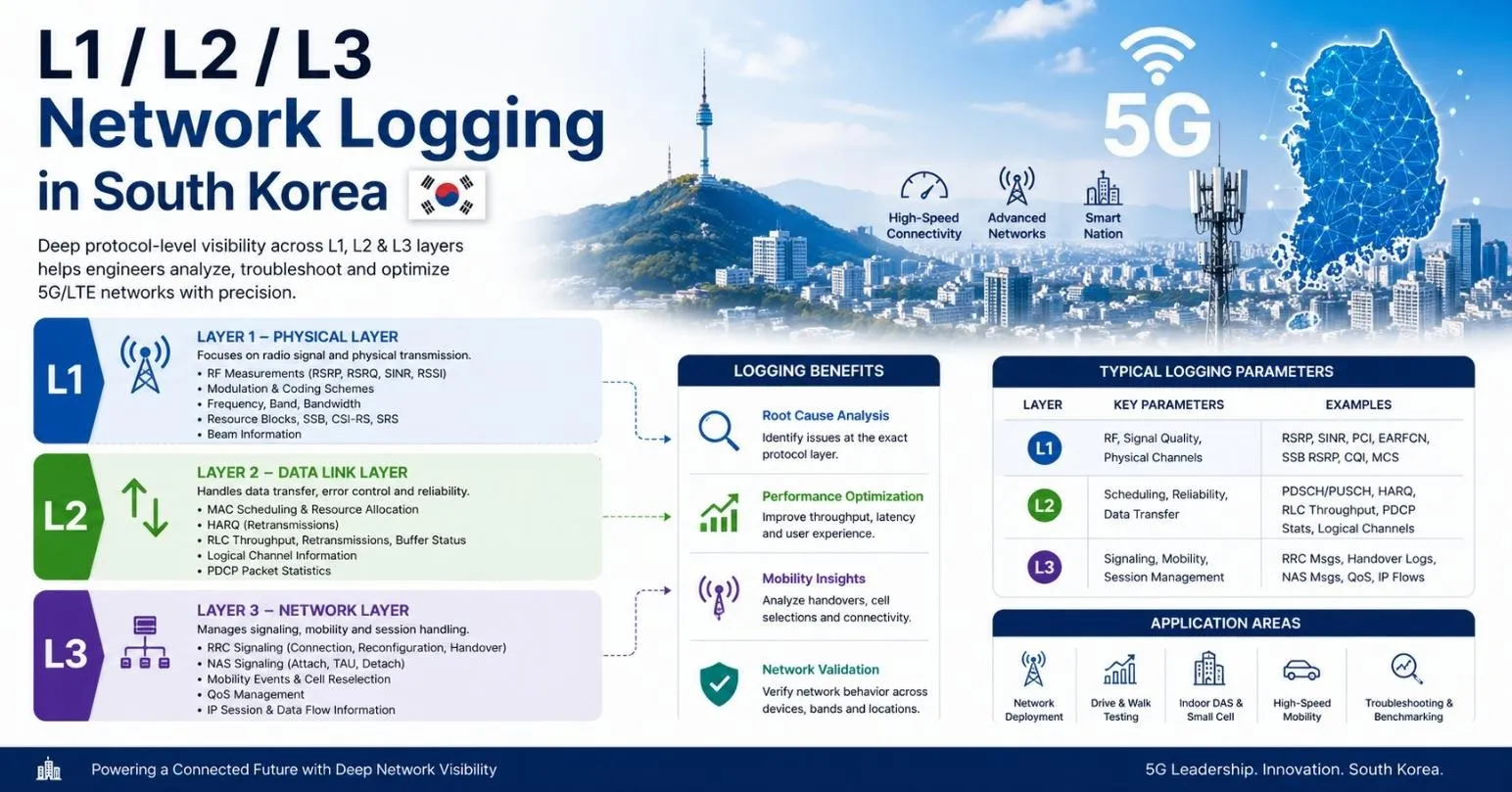
Understanding L1, L2, and L3 in Practical Terms
L1, L2, and L3 represent different layers of communication between the device and the network.
- Layer 1 (Physical Layer) deals with radio signals. It includes parameters such as signal strength, modulation schemes, frequency bands, and resource block allocation.
- Layer 2 (MAC/RLC/PDCP) handles scheduling, retransmissions, and data flow control. It shows how efficiently data is being transmitted over the air.
- Layer 3 (RRC/NAS) manages signaling, mobility, session setup, and handovers.
In South Korea’s network environment, all three layers are used together during testing. Engineers rarely depend on a single layer because issues often span across multiple layers.
Why South Korea Focuses on Deep Logging
South Korea has high user density, especially in urban areas like Seoul, Busan, and Incheon. These regions have complex radio environments due to:
- High rise buildings
- Indoor heavy traffic usage
- Multi band aggregation (LTE + NR)
- Frequent handovers in mobility scenarios
Because of this, surface level metrics like download speed or RSRP are not enough. Operators require detailed logs to understand:
- Why throughput drops even when signal strength is good
- Why handovers fail in dense deployments
- Why uplink performance is unstable in certain areas
L1/L2/L3 logging provides this level of visibility.
Field Use Cases in South Korea
1. Mobility and Handover Analysis
South Korea’s 5G networks are highly dense, which leads to frequent cell transitions. During drive testing, engineers capture L3 logs to analyze:
- RRC connection reconfigurations
- Handover commands and failures
- Measurement reports from the device
At the same time, L1 and L2 logs help identify if the issue is related to radio quality or scheduling delays.
For example, a handover may fail not because of poor signal strength, but due to delayed scheduling at the MAC layer. Without L2 logs, this issue would remain hidden.
2. Uplink Performance and TX Power Behavior
Uplink performance is becoming a major focus, especially for applications like video uploads, real time communication, and enterprise use cases.
In South Korea, engineers analyze:
- TX power levels from L1 logs
- PUCCH and PUSCH behavior
- Scheduling grants from L2
These parameters help identify whether the device is reaching maximum transmit power or being limited by the network.
In many cases, uplink issues are not due to poor coverage but due to resource allocation or interference. This can only be confirmed through lower layer logs.
3. Carrier Aggregation and Multi Band Testing
Operators in South Korea use multiple frequency bands for both LTE and 5G. Devices often connect to multiple carriers simultaneously.
L1 logs show:
- Active bands
- Carrier combinations
- Signal quality per band
L2 logs show:
- Data distribution across carriers
- Scheduling efficiency
L3 logs show:
- Configuration messages for carrier aggregation
This combined view is required to verify if the network is using all available resources correctly.
4. Indoor DAS and Small Cell Testing
Indoor coverage is a major priority in South Korea. Shopping malls, subway stations, and office buildings use DAS or small cell systems.
In these environments, engineers use logging to check:
- Signal consistency across floors
- Cell reselection behavior
- Interference between indoor and outdoor layers
L3 logs help track mobility events inside buildings, while L1 logs show signal fluctuations caused by reflections and attenuation.
Tools and Device Considerations
To capture L1/L2/L3 logs, standard smartphones are not enough. In South Korea, engineers use:
- Rooted Android devices
- Qualcomm based chipsets with diagnostic access
- Specialized logging tools
Device selection is important because not all chipsets expose the same level of detail. For example:
- Some devices provide full L1/L2/L3 logs
- Others limit access to only L3 signaling
This is why device compatibility is always verified before testing begins.
Challenges Observed in South Korea
Even with advanced infrastructure, several challenges remain:
1. Data Volume
Logging generates large amounts of data. A single drive test can produce gigabytes of logs. Managing and analyzing this data requires proper tools and workflows.
2. Complexity in Analysis
Logs are not easy to interpret. Engineers need experience to correlate events across layers. For example:
- A drop in throughput may relate to L2 scheduling
- But the root cause may be interference seen in L1
3. Device Dependency
Results can vary depending on the device used. This makes it necessary to standardize testing devices for consistent results.
Shift Toward Automation and Cloud Analysis
South Korea is also moving toward cloud based log analysis. Instead of manual processing, logs are uploaded to centralized systems where:
- Data is parsed automatically
- KPIs are generated
- Anomalies are detected
This reduces analysis time and helps teams focus on problem solving rather than data handling.
AI based tools are also being explored to identify patterns in logs, especially for large scale deployments.
Relevance for 6G Preparation
Although 6G is still in early stages, South Korea is already preparing for it. Future networks will involve:
- Higher frequency bands
- More complex beamforming
- AI driven scheduling
This will increase the need for deeper logging. L1/L2/L3 analysis will continue to play a key role, but tools will need to evolve to handle more complex data structures.
Conclusion
L1, L2, and L3 logging is a standard part of network validation in South Korea. It is used across different scenarios, including mobility testing, uplink analysis, indoor coverage validation, and multi band optimization.
The main reason for its importance is simple: modern networks are too complex to understand using surface level metrics alone.
Engineers in South Korea rely on these logs to identify real issues, validate network behavior, and ensure consistent performance across different environments.
As networks continue to evolve, the role of protocol level logging will remain central to telecom operations.
About RantCell
RantCell is a mobile network testing and analytics solution designed to help telecom operators, enterprises, and system integrators measure, analyze, and optimize network performance. It supports both indoor and outdoor testing, enabling real time visibility into key KPIs such as signal strength, throughput, latency, and mobility performance.
With advanced capabilities like multi device testing, cloud based reporting, and support for L1/L2/L3 level insights (ProPlus), RantCell simplifies network validation across technologies including 4G, 5G, and CBRS environments. Also read similar articles from here.